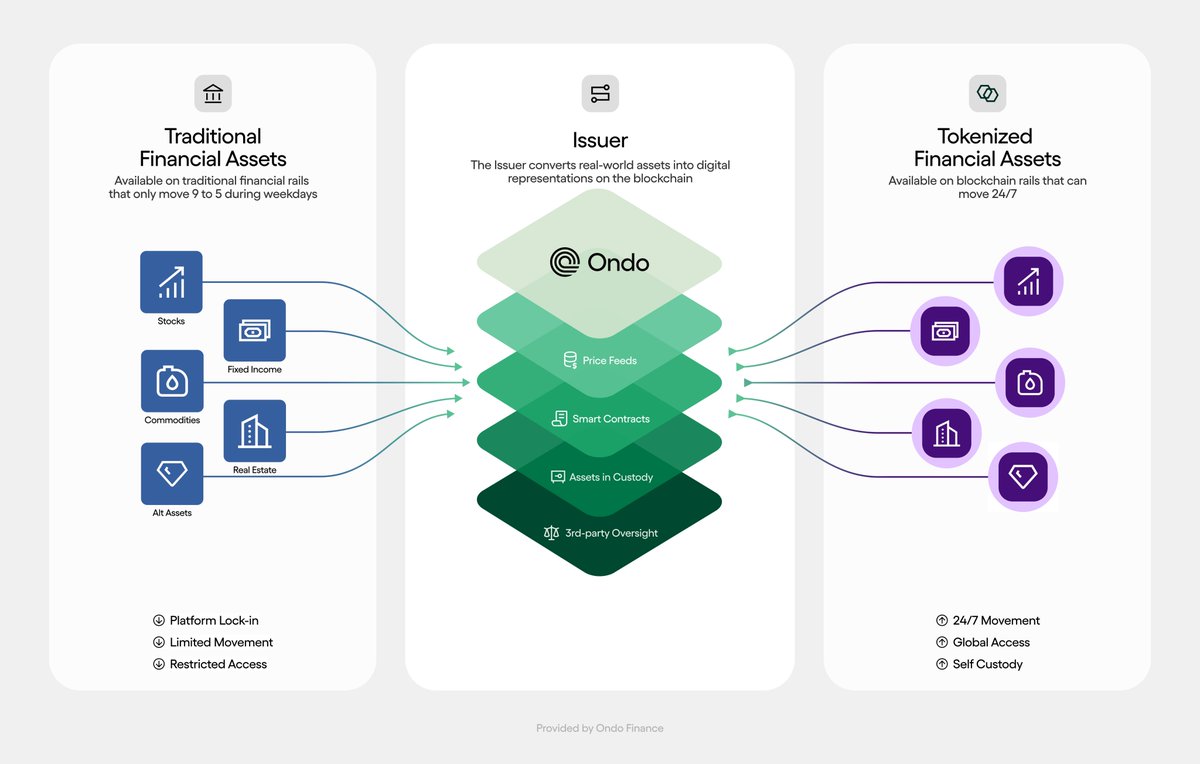
Ondo Finance is a decentralized platform that tokenizes US Treasury bonds, enabling investors to earn yield from traditional assets via blockchain. The OUSD stablecoin is backed by short-term Treasuries with dynamic yield adjustments based on Federal Reserve rates. This tokenization process democratizes bond investing by lowering minimum thresholds and providing real-time reserve transparency.
What is Ondo Finance and How It Connects to US Bonds
Ondo Finance bridges traditional finance with DeFi by tokenizing low-risk assets like US Treasuries. The team includes former Goldman Sachs and SEC executives, lending institutional credibility to the platform.
Key Features of OUSD
- Collateralization: Each OUSD is 1:1 backed by short-term US Treasuries
- Yield: Automated interest payments via smart contracts
- Audits: Independent reserve verification by third-party auditors
- Liquidity: No lock-up periods for withdrawals
- Accessibility: Global availability with no KYC for small amounts
How Treasury Tokenization Works
Ondo Finance purchases actual bonds through trusts, then represents them as digital tokens. Investors access these through OUSD, bypassing traditional market complexities.
Technical Implementation
- Smart contracts automate coupon payments
- Real-time reserve updates on-chain
- Ethereum-based security infrastructure
- Auto-rebalancing for bond maturity changes
- Chainlink price oracles for accurate asset valuation
How to Invest via Ondo Finance: Step-by-Step
- Set up an Ethereum wallet (MetaMask, Ledger)
- Acquire ETH or USDC on exchanges (Binance, Coinbase)
- Swap for OUSD via Uniswap or Ondo's minter
- Stake OUSD to earn yield
Advanced Strategies
- Liquidity farming: Provide OUSD to DEX pools
- DeFi integration: Use as collateral on Aave/Compound
- Automated strategies: Connect to Yearn Finance robo-advisors
Comparison with Traditional Bond ETFs
Key differences between tokenized bonds and conventional ETFs:
- Access: $1 minimum vs $100+ for brokers
- Trading: 24/7 markets vs exchange hours
- Transparency: On-chain verification
- Fees: 0.15% vs 0.3-0.5% for ETFs
- Settlement: Minutes vs T+2 days
Risks of Tokenized Bonds
- Regulatory uncertainty: Potential SEC securities classification
- Smart contract vulnerabilities (audited by OpenZeppelin)
- Lower liquidity than ETFs like BIL
- Stablecoin peg volatility
- Custody risk with bond trust providers
Risk Mitigation
- Deposit insurance via Nexus Mutual
- Multi-signature reserve wallets
- Gradual limits for new users
Future of Asset Tokenization
Ondo's roadmap includes:
- Corporate bond tokenization
- Municipal bond experiments
- Layer 2 integration (Arbitrum, Optimism)
- Cross-chain compatibility
- TradFi partnerships
Market Outlook
Analysts project tokenized assets could reach $16T by 2030, with bonds comprising 25-30%.
Questions & Answers
What yield do Ondo's tokenized bonds offer?
OUSD yields 4-6% APY, tracking Fed rates. Real-time rates are displayed on Ondo's dashboard.
How does OUSD differ from USDT/USDC?
OUSD is Treasury-backed versus cash-backed stablecoins, offering higher yield at comparable risk.
What are the tax implications?
Varies by jurisdiction: treated as interest income in US, capital gains in some EU countries.
How to verify OUSD reserves?
Ondo publishes on-chain reserve reports with monthly audits by Grant Thornton.
Are there withdrawal limits?
No hard limits, but withdrawals >$1M may require AML verification.
What are the fees?
0.1% mint/redeem fee + 0.15% management fee, plus Ethereum gas costs.
Additional Tokenization Insights
Hedge funds are adopting tokenized bonds as repo alternatives. Messari reports 340% growth in tokenized sovereign debt during 2023.
Investor Geography
- Asia: 42% (Singapore/Hong Kong dominant)
- Europe: 33% (Germany/Switzerland)
- US: 18% (post-OUSD launch growth)
- Other: 7%
Conclusion
Ondo Finance creates a DeFi bridge to Treasury yields, particularly valuable for investors in unstable economies with limited traditional access.