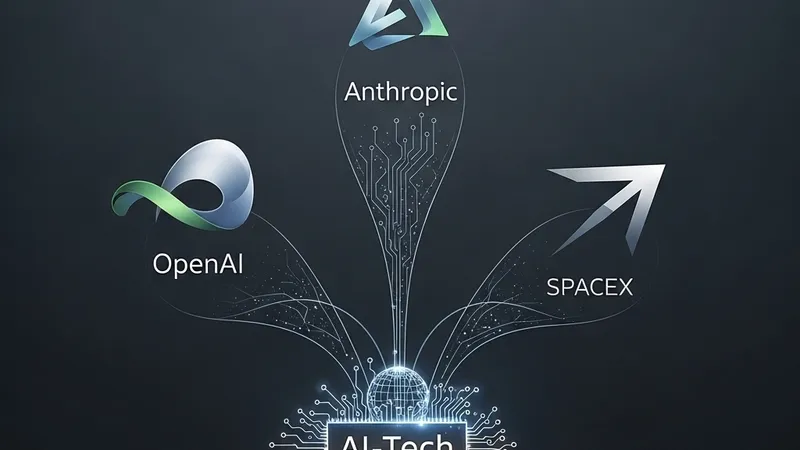
SpaceX, Anthropic and OpenAI have set unprecedented market capitalization records with their public listings. Their combined IPO valuations exceed $4 trillion - more than all tech IPOs of the past 25 years combined. SpaceX already debuted at $1.77 trillion, while Anthropic and OpenAI prepare trillion-dollar listings that will permanently alter investment dynamics.
Record-Breaking Public Debuts
SpaceX's $1.77 trillion market cap at listing already set a new benchmark. Anthropic and OpenAI are preparing IPOs that could each surpass $2 trillion valuations. For context, the total value of all tech IPOs since 1999 was $70 billion.
Historical Comparisons
- Google (2004): $23 billion
- Tesla (2010): $2 billion
- Meta (2012): $104 billion
- Uber (2019): $84 billion
Global Context
Alibaba's $25 billion 2014 IPO held the global record until now. The current SpaceX and AI company listings dwarf that figure by orders of magnitude. Even within US markets alone, the gap with previous decades is staggering.
Why This Matters Now
Companies stay private longer to build valuation pre-IPO. AI development requires massive capital, inflating valuations. Financial infrastructure strains under deal sizes.
Venture Capital Shifts
VCs now keep companies private for 10-15 years vs. the traditional 5-7. This avoids early public market pressures while scaling tech. OpenAI, founded in 2015, only now prepares its IPO.
Geopolitical Implications
The tech giant race carries strategic weight. Chinese firms like ByteDance and Alibaba Cloud develop competing AI platforms but trail in valuation. US regulators already consider restricting foreign investment in critical AI technologies.
Investor Considerations
AI dominates private investment flows. Unprecedented valuations create overvaluation and volatility risks. Investors should monitor IPO dates and market reactions closely.
Actionable Steps
- Analyze pre-IPO quarterly reports
- Diversify across AI, space and traditional tech
- Track AI regulatory risks
- Focus on long-term potential over short-term swings
- Monitor volatility indexes for position adjustments
Tech Sector Impact
Intensified competition among tech giants is inevitable. Other companies may alter IPO strategies. Global markets already feel these listings' effects.
Startup Ecosystem Changes
Young companies now pursue more aggressive valuations. Average Series A rounds for AI startups grew from $10-15M to $25-40M in three years, creating both opportunity and overheating risks.
Talent Market Shifts
Top AI researcher salaries jumped 35-50% last year. Companies pay up to $1M annually for generative AI leads, creating talent shortages in conventional IT sectors.
What to Watch
- Anthropic and OpenAI IPO dates
- Market reactions to initial trading
- Investment landscape changes
- EU/US AI regulatory decisions
- SpaceX stock performance in first six months
- AI sector employment trends
Questions & Answers
What's SpaceX's post-IPO valuation?
SpaceX debuted at $1.77 trillion, a tech industry record. Initial trading showed 12% gains, indicating strong institutional interest. Morgan Stanley analysts predict $2 trillion market cap within 12 months.
When is OpenAI's IPO expected?
No official date yet, but OpenAI's IPO is anticipated within 12 months. Insiders report the company is finalizing financial audits and negotiating with lead underwriters. Goldman Sachs and JPMorgan compete for key roles.
How will these IPOs affect AI markets?
AI sectors will gain funding but face potential overvaluation and volatility. Analysts project three scenarios:
- 40-60% increase in AI startup investment
- Market correction within 12-18 months
- Accelerated regulatory oversight
- New industry standards emerging
What are the investor risks?
Primary risks are overvaluation and post-IPO volatility. Additional factors:
- Technology development delays
- Regulatory changes
- Chinese competition
- AI ethics concerns
- AI chip shortages
How do these compare to Google/Meta IPOs?
Combined, these listings surpass all tech IPOs since 1999 including Google and Meta. Inflation-adjusted, the gap widens to 15x superiority. Unlike Google/Meta which went public profitable, some AI companies show only growth potential.
Why stay private longer?
Companies build value pre-IPO to attract investment and minimize risk. Key reasons:
- Private capital access via SPAC/PIPE deals
- No quarterly earnings pressure
- Business model testing without public scrutiny
- More flexible private company regulation
- Secondary markets for private shares
How will VC markets change?
Capital reallocation expected:
| Sector | Projected investment growth | Key players |
|---|---|---|
| AI infrastructure | +70-90% | Nvidia, AMD, Cerebras |
| Space tech | +50-60% | Blue Origin, Relativity Space |
| Traditional software | -10-15% | Oracle, SAP |